When choosing a compound bow, draw weight directly shapes how far and how accurately you can shoot. Many archers and hunters ask: How does draw weight affect compound bow range? What are the real-world effective and maximum ranges for different poundages? This guide breaks down compound bow range by draw weight, explains the science behind speed and energy, and helps you match poundage to your hunting, target, or recreational goals.
What Is Draw Weight & Why It Matters for Range
Draw weight, measured in pounds (lbs), is the peak force needed to pull a compound bow to full draw. Modern compound bows use cam systems to deliver high let‑off, so holding weight is much lower than peak weight. More draw weight means more stored energy, faster arrow velocity (measured in feet per second, FPS), flatter trajectory, and greater downrange power.
As a general rule: every 10 lbs of draw weight adds 15–20 FPS to arrow speed. Faster arrows resist wind drift, drop less over distance, and maintain kinetic energy (KE) farther. This directly boosts both effective range (accurate, consistent hits) and maximum range (the farthest an arrow can fly).
Key Definitions: Effective Range vs. Maximum Range
Before comparing poundages, clarify two critical terms:
- Effective Range: The distance you can repeatedly hit a target with acceptable accuracy and sufficient energy for hunting or scoring. This is the usable range for real‑world shooting.
- Maximum Range: The absolute farthest an arrow can travel when shot at a high angle, with no regard for accuracy or lethality. Maximum range is a theoretical number, not practical for hunting or competition.
Compound Bow Range by Draw Weight (Real‑World Data)
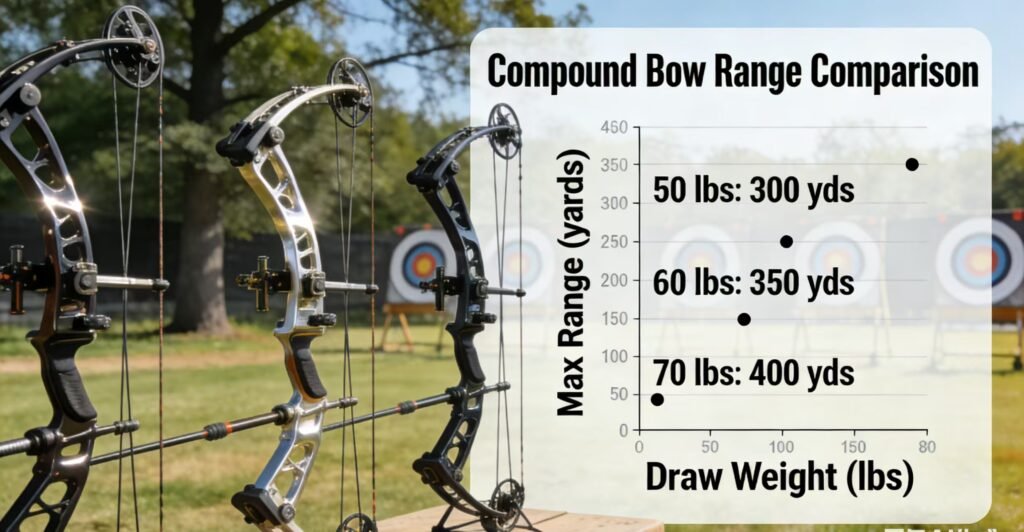
Below are typical effective and maximum ranges for common compound bow draw weights, based on standard setup: 28–30 inch draw length, 350–400 grain carbon arrow, tuned bow, and average archer skill.
10–25 lbs: Youth & Beginner Bows
- Effective Range: 10–30 yards
- Maximum Range: 100–180 yards
Light poundage bows are designed for kids, new archers, and small‑game practice. They produce low FPS (120–180) and minimal KE, so accuracy drops quickly past 20 yards. Maximum range is limited by low stored energy. These bows prioritize control and safety over distance.
30–35 lbs: Women, Youth, & Recreational Shooting
- Effective Range: 30–45 yards
- Maximum Range: 200–300 yards
This poundage works well for casual target shooting and small‑game hunting. Arrows reach 180–220 FPS, with enough stability for consistent groups at 30–40 yards. Effective range tops out around 45 yards for most archers, as speed and energy fade beyond that distance.
40–45 lbs: All‑Around Target & Medium Game
- Effective Range: 45–60 yards
- Maximum Range: 280–350 yards
A versatile sweet spot for many archers. 40–45 lbs delivers 220–260 FPS, enough KE for ethical medium‑game harvest and tight groups at 50+ yards. Target archers and spot‑and‑stalk hunters favor this range for balance of power, accuracy, and shootability.
50–60 lbs: Popular Hunting & Competitive Setup
- Effective Range: 60–80 yards
- Maximum Range: 350–400 yards
The most common draw weight for adult hunters and competitive shooters. 50–60 lbs pushes arrows to 260–300 FPS, with strong downrange energy and a flat trajectory. Skilled archers can hold accuracy to 80 yards in ideal conditions, while ethical hunting range stays 40–60 yards for clean kills.
65–70 lbs: High‑Performance Hunting & Long‑Range Shooting
- Effective Range: 70–90+ yards
- Maximum Range: 400–450+ yards
Top‑tier poundage for large game, long‑range target, and experienced shooters. 65–70 lbs yields 300–340+ FPS IBO speed, maximum KE, and minimal arrow drop. Professional archers can reach accurate shots past 90 yards, but most hunters limit ethical shots to 60 yards or less to ensure penetration and precision.
Other Factors That Change Compound Bow Range
Draw weight is critical, but these variables also shift effective and maximum range:
- Arrow Weight: Lighter arrows fly faster and farther; heavier arrows retain KE and penetrate better but reduce maximum range.
- Draw Length: Every 1 inch of draw length adds ~10 FPS, extending usable range.
- Bow Efficiency: Cam design, limb quality, and tuning affect energy transfer and speed.
- Archery Skill: Form, release, and consistency define your personal effective range more than raw poundage.
- Environment: Wind, altitude, and temperature alter arrow flight and effective range.
How to Choose the Right Draw Weight for Your Range Goals
- Beginners & Youth: Start at 10–35 lbs. Prioritize smooth draw and consistent accuracy over maximum distance.
- Recreational & Target Shooting: 35–50 lbs offers great accuracy at 30–60 yards with less fatigue.
- Medium‑Game Hunting: 40–50 lbs provides enough KE and effective range for deer, antelope, and similar game.
- Large‑Game Hunting: 50–70 lbs ensures penetration at ethical hunting ranges (30–60 yards).
- Long‑Range & Competition: 60–70 lbs maximizes speed and effective range for 80+ yard shots.
Remember: A manageable draw weight that you can shoot accurately is better than an overly heavy bow that causes fatigue and missed shots.
Final Thoughts
Compound bow range is ruled by draw weight, but effective range depends on more than just poundage. Higher draw weight delivers faster arrows, more energy, and greater potential distance, but your skill, equipment, and shooting style determine your actual usable range. Use the ranges above as a benchmark, then test and tune your setup to find your personal accurate, effective distance.
Whether you’re shooting targets in the backyard or hunting in the field, understanding draw weight and range helps you make better equipment choices, shoot more confidently, and perform at your best.