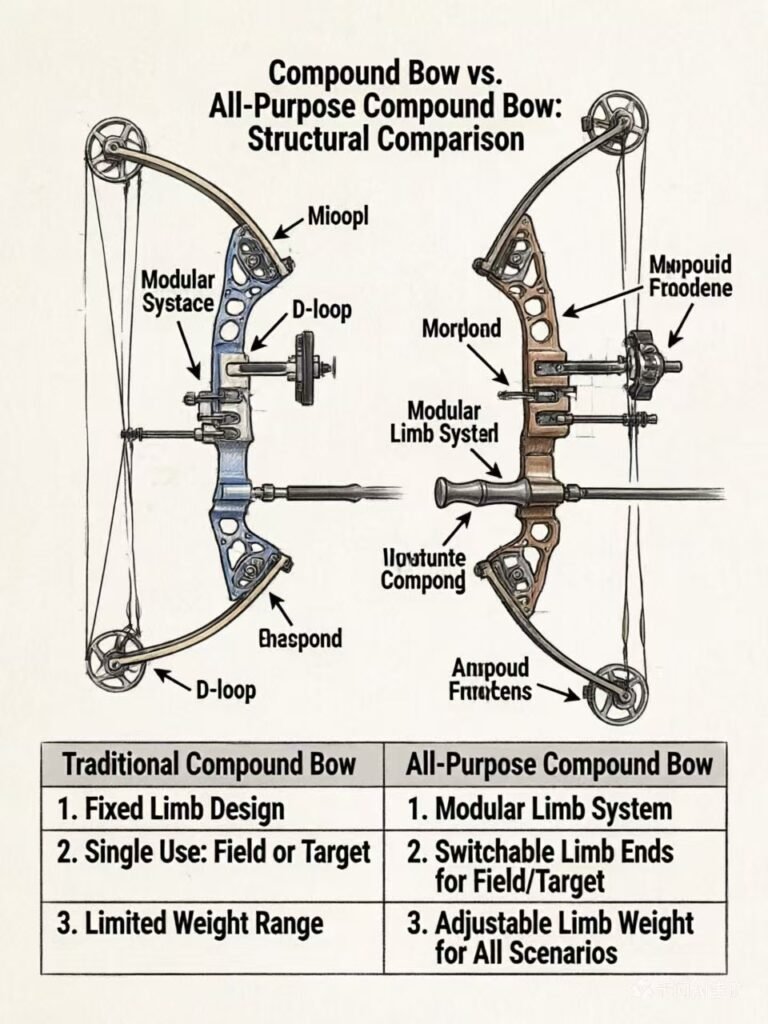
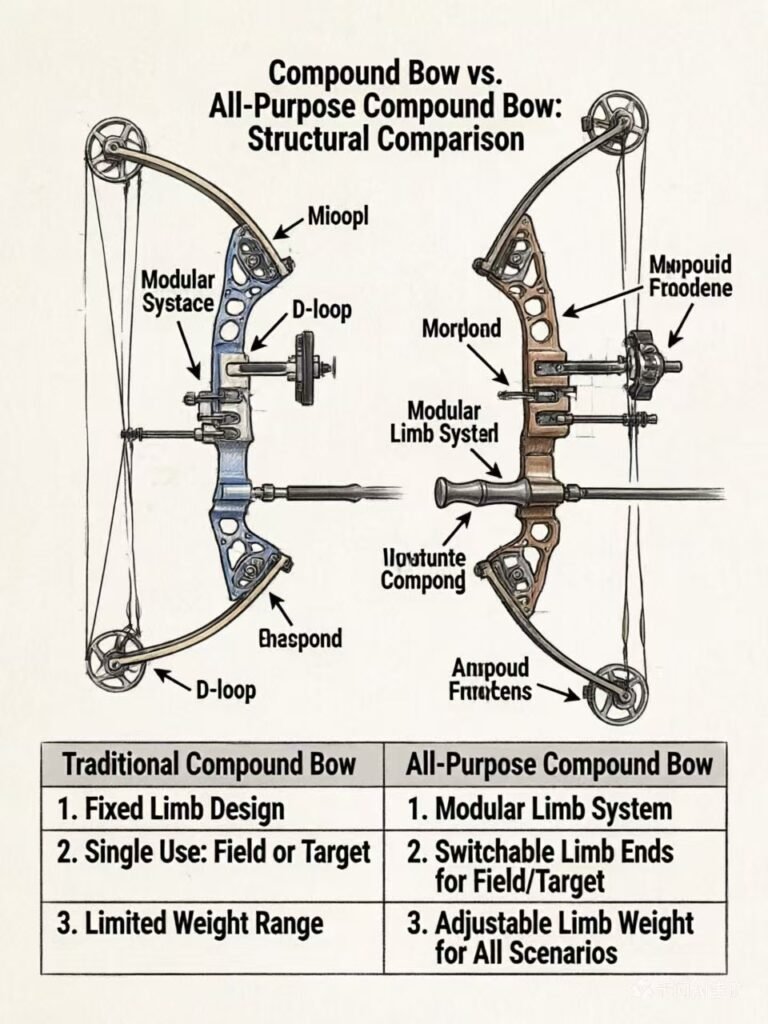
In the dynamic world of bow archery, few pieces of equipment have revolutionized the sport quite like the compound bow. By utilizing a clever system of cables and cams (eccentric wheels), the bow archery compound bow offers a mechanical advantage known as “let-off.” This allows an archer to hold a heavy draw weight at full draw with significantly less effort, enabling steady aiming and precise shooting. However, as the market has evolved, a distinct category has emerged to challenge the dominance of specialized equipment: the dual-use compound bow (often called a hybrid or adjustable compound bow). While both types rely on the same fundamental physics, they serve very different purposes. Understanding the divergence between a dedicated standard compound bow and a versatile dual-use model is essential for anyone looking to invest in this thrilling sport.
The Engineering Divide: Optimization vs. Adaptability
A standard, high-performance bow archery compound bow is typically engineered with a singular focus: maximum efficiency for a specific discipline, such as target competition or big-game hunting. These bows are built for peak performance. For instance, a dedicated target bow will feature a long axle-to-axle length (often over 34 inches) to provide a stable platform and extreme forgiveness for tiny groups at long distances. Conversely, a specialized hunting bow is designed to be compact and agile, prioritizing high arrow speeds (often exceeding 340 feet per second) and stealth.
The defining characteristic of a standard compound bow is its commitment to a specific “tune.” The draw length and draw weight are often fixed or require a professional bow press and technical expertise to adjust. The cam timing is synchronized to the millisecond to ensure the string leaves the nock at the perfect angle every time. This lack of flexibility is a trade-off for perfection; the bow does one thing, but it does it exceptionally well.
In contrast, the dual-use bow archer compound bow is the “Swiss Army Knife” of the archery world. These bows are designed with flexibility as their primary metric. They feature modular cam systems that allow the user to adjust the draw length (often ranging from 19 to 30 inches) and limb bolts that permit significant weight adjustments (e.g., from 15 to 70 pounds) without the need for a bow press. This makes them incredibly accessible. A dual-use bow sacrifices a fraction of the raw speed and “stacking” smoothness found in top-tier specialized bows to offer a user-friendly experience that can adapt to different shooters and scenarios.
Practical Application and User Scenarios
The choice between these two types of bow archery equipment ultimately comes down to the intended application. A standard bow archery compound bow is a specialized tool. If you are a competitive shooter aiming for the bullseye at 70 meters, or a hunter tracking elk in the Rocky Mountains, the marginal gains in speed and stability offered by a standard bow are non-negotiable. The rigid design ensures that every shot is consistent, provided the archer’s form remains consistent.
However, the dual-use compound bow shines in recreational and family settings. Because of its wide adjustability, it is the ideal choice for growing youths who may need to increase their draw weight every year, or for families where a single bow needs to be shared between a father and a teenage son. Furthermore, for the casual shooter who enjoys backyard target practice in the summer and perhaps light hunting in the fall, a dual-use bow offers the versatility to handle both tasks without requiring two separate investments.
Recommendations: Which Bow is Right for You?
To help you navigate the aisles of your local archery shop, here is a breakdown of which bow suits which demographic.
- The Standard Bow Archery Compound Bow: For the Committed Specialist
This bow is best suited for the experienced hunter or competitive target archer. If your goal is to harvest large game where kinetic energy is paramount, or if you are competing in 3D archery tournaments where fractions of an inch determine the winner, you need the consistency and speed of a standard compound bow. It is also suitable for adults who have reached their full physical maturity and know their exact draw length and preferred weight, requiring a “set it and forget it” machine that demands minimal adjustment. - The Dual-Use Bow Archery Compound Bow: For the Versatile Explorer
This bow is the clear winner for beginners, families, and recreational shooters. If you are new to bow archery and are unsure if you will prefer hunting or target shooting, a dual-use bow allows you to try both without breaking the bank. It is also the practical choice for parents buying a first bow for a child; the ability to dial the weight down to 15 pounds and crank it up to 50 pounds as the child grows makes it a long-term investment. Additionally, for the “weekend warrior” who wants a single quiver for various activities—from pest control to paper target punching—the dual-use model provides the necessary adaptability to excel in multiple environments.
In conclusion, while the standard compound bow represents the pinnacle of mechanical efficiency, the dual-use compound bow represents the spirit of accessibility. Both have their place in the sport, and choosing the right one depends entirely on whether you value specialization or versatility more.