The Symbiotic Relationship: Matching Arrows to the Modern Compound Bow
The modern compound bow represents the apex of archery engineering, a sophisticated integration of physics, materials science, and mechanical advantage. However, even the most expensive, precisely tuned compound bow is rendered ineffective without the correct projectile. The relationship between the compound bow and arrow is not merely one of launcher and projectile; it is a symbiotic dynamic where the arrow acts as the final tuning fork for the bow’s energy. Selecting the wrong arrow can result in poor accuracy, reduced kinetic energy, or even permanent damage to the bow’s limbs and cams. Therefore, understanding the nuances of arrow selection—specifically spine, weight, and length—is paramount for any serious archer.
The Critical Role of Dynamic Spine
The most critical factor in matching an arrow to a compound bow is the dynamic spine, or the stiffness of the arrow shaft. Unlike static spine, which measures deflection under a static weight, dynamic spine refers to how the arrow behaves during the violent acceleration of the shot. When a compound bow is released, the string does not travel forward in a perfectly straight line; due to the mechanics of the release and the flex of the bow, the string oscillates slightly. The arrow must flex around the arrow rest (the “Archer’s Paradox”) and then recover its straightness in flight.
If an arrow is too weak (too flexible) for a specific bow setup, it will over-flex upon release. This results in the nock end of the arrow kicking out too far, causing the fletching to strike the rest or the arrow to plane off-target, typically to the right for a right-handed archer. Conversely, if an arrow is too stiff (too rigid), it will not flex enough to navigate around the riser cleanly. It will resist the string’s oscillation, leading to erratic flight paths, often grouping to the left for a right-handed archer, and creating excessive vibration upon release.
Matching the spine requires analyzing the bow’s draw weight and the arrow’s length. A higher draw weight exerts more force on the shaft, requiring a stiffer spine to resist buckling. Similarly, a longer arrow acts as a longer lever, making it effectively weaker; thus, a longer arrow requires a stiffer spine to compensate. Modern archers rely on manufacturer charts that cross-reference draw weight, arrow length, and point weight to find the perfect spine match, ensuring the arrow leaves the bow with a predictable, stable oscillation.
Kinetic Energy and Momentum: The Weight Equation
Beyond stiffness, the weight of the arrow is a fundamental variable that dictates the performance characteristics of the compound bow and arrow system. Arrow weight is generally measured in grains, and the total weight includes the shaft, insert, point, nock, and fletching. The industry standard for safety, established by the Archery Trade Association (formerly AMO), suggests a minimum arrow weight of 5 grains per pound of draw weight. For a 70-pound bow, this means the arrow should weigh at least 350 grains. Shooting lighter than this limit is dangerous; if the arrow is too light, it cannot absorb all the energy stored in the limbs, causing the excess energy to reverberate back into the bow. This “dry fire” effect can crack limbs, damage cams, or break strings.
For hunting applications, the trend leans heavily toward heavier arrows. A “heavy” arrow—often exceeding 8 to 10 grains per pound—offers distinct advantages. Heavier arrows absorb more of the bow’s stored energy, resulting in a quieter shot with less vibration. More importantly, they possess higher momentum and kinetic energy retention downrange. A heavier arrow is less affected by wind drift and retains its velocity better over distance. When striking a target, the increased mass contributes to deeper penetration, which is crucial for ethical hunting.
Conversely, target archers often prefer lighter arrows. A lighter arrow leaves the bow at a higher initial velocity, resulting in a flatter trajectory. This “flat shooting” characteristic minimizes the need for extreme elevation adjustments at varying distances, simplifying the aiming process in 3D or target competitions. However, this comes at the cost of increased noise and slightly reduced penetration potential. The choice between a light, fast arrow and a heavy, penetrating arrow is a trade-off that every archer must make based on their specific discipline.
Front of Center (FOC) and Aerodynamics
The balance point of the arrow, known as the Front of Center (FOC), is another subtle yet powerful tuning element. FOC is the percentage of the arrow’s total weight that is located in the front half of the shaft. By installing heavier points or using heavier inserts, an archer can increase the FOC. A higher FOC improves the arrow’s stability in flight, much like a dart. It ensures that the heavy front end pulls the arrow straight, making it more resistant to crosswinds and steering errors. For broadhead hunting, where the aerodynamic drag of the blades can cause the arrow to plane off-course, a high FOC is essential to force the arrow to follow the point.
Aerodynamics also play a role in the selection of the shaft diameter and fletching. Small-diameter arrows, often favored in competition, present less surface area to the wind, reducing drift. Large-diameter arrows, conversely, may offer better wall thickness for durability or specific flight characteristics. The fletching (vanes or feathers) must also be matched to the arrow’s rotation and the bow’s speed. Stiff vanes are required for high-speed compound bows to withstand the shock of the release, whereas feathers, which collapse upon contact with the rest, are generally reserved for traditional setups or low-speed bows.
Length, Safety, and Material Composition
Finally, the physical length of the arrow must be tailored to the archer’s draw length. An arrow that is too short is a severe safety hazard; drawing an arrow behind the arrow rest can result in the arrow falling off the rest or, worse, the archer drawing the arrowhead back into their hand or the bow handle, leading to catastrophic failure upon release. The general rule is to cut the arrow approximately 1 to 2 inches longer than the archer’s draw length. This ensures that the nock remains on the string and the point remains clear of the riser throughout the entire draw cycle.
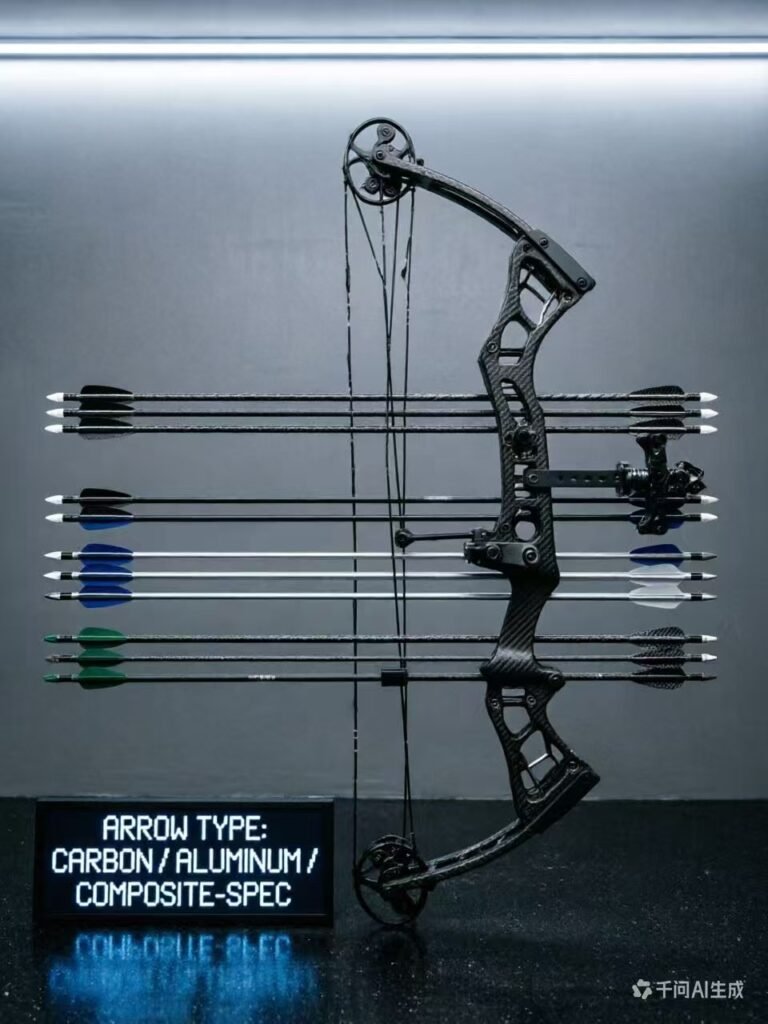
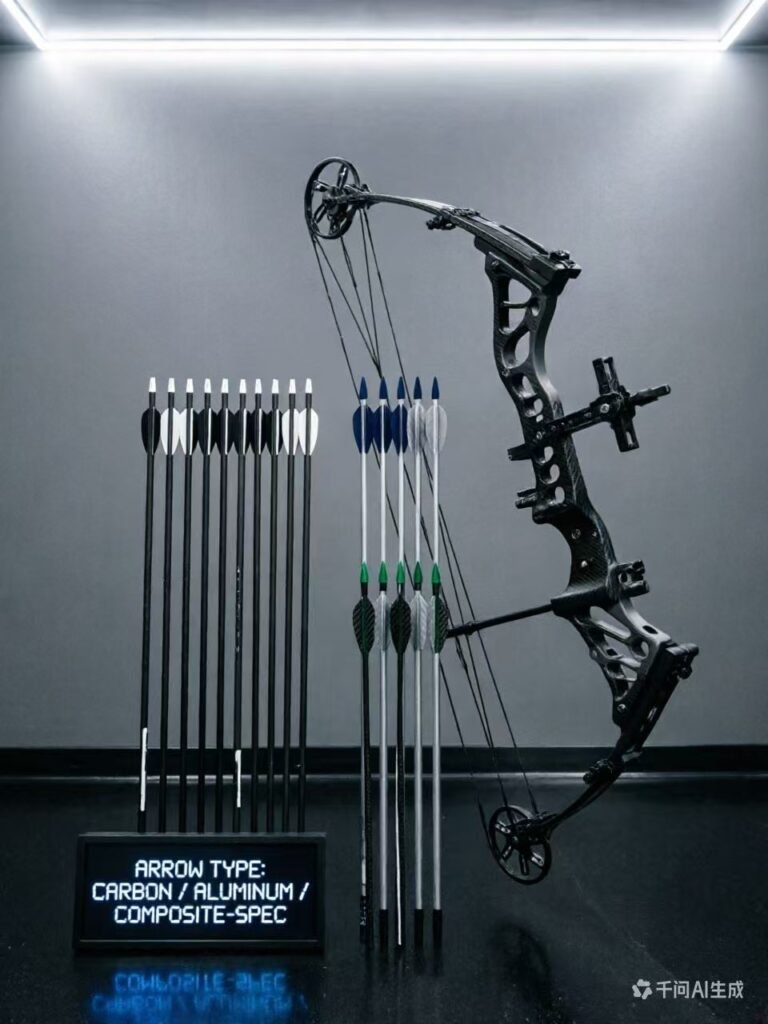
Material choice—carbon, aluminum, or a composite of both—further refines the match. Carbon arrows are the modern standard for compound bows due to their high strength-to-weight ratio and consistency. They can be manufactured to precise spine tolerances and are incredibly durable. Aluminum arrows, while less common in high-speed hunting, offer perfect straightness and are often used in indoor target archery where wind is not a factor and consistent grouping is the only metric that matters.
In conclusion, the compound bow and arrow relationship is defined by precision engineering. There is no such thing as a “universal” arrow. The perfect arrow is one that is cut to the exact length of the archer, spined to the specific poundage of the bow, and weighted to match the intended application. When these variables align, the system functions as a singular entity, translating the stored potential energy of the limbs into a projectile that flies with true, lethal accuracy.