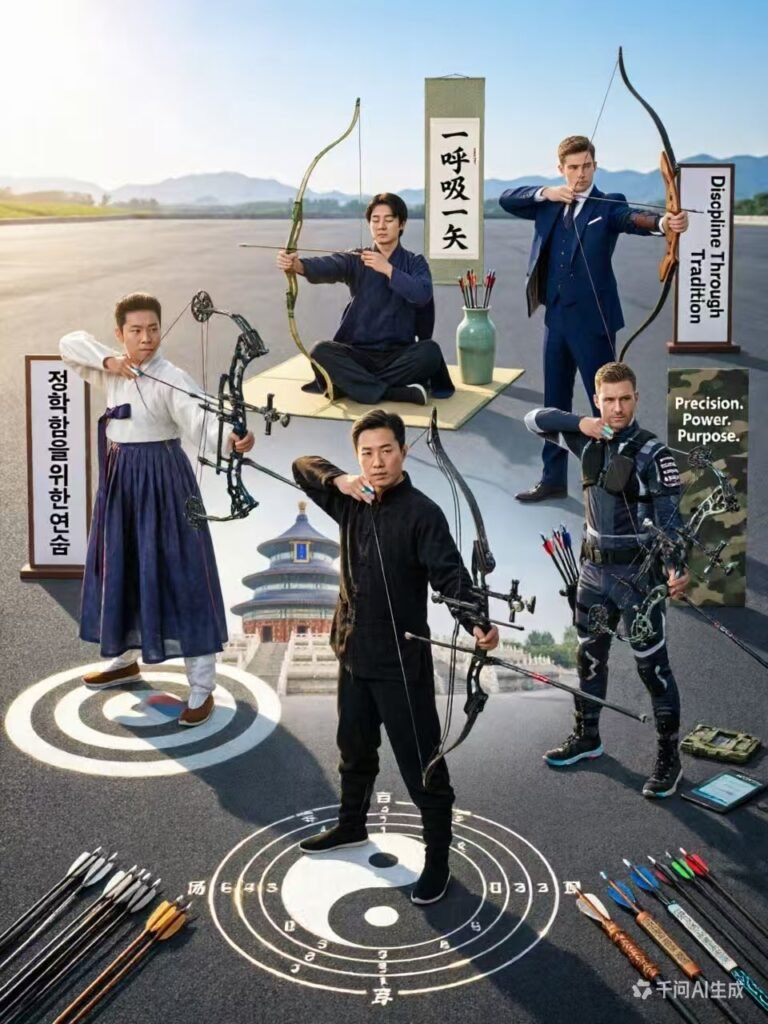
Archery is a fascinating sport that retains the lethality of ancient warfare while evolving into the elegance of modern competition. Although athletes worldwide now use modern compound or recurve bows, distinct traditions and preferences in training philosophy, competition style, and equipment have emerged due to differing cultural backgrounds.
🇰🇷 South Korea: Extreme Discipline and “The Grind”
South Korea holds absolute dominance in modern archery, with traditions leaning towards an industrialized, systematic training regime.
- Hellish Selection Process: There is a saying in Korean archery: “Winning the national trials is harder than winning the Olympics.” The internal competition is brutal. Their tradition is that “domestic rivalry outweighs international competition,” creating athletes with incredibly strong mental fortitude.
- Mental Cultivation: Korean archery emphasizes mental training as much as physical technique. Athletes practice focus in noisy environments (with people banging gongs or drums) to simulate the pressure of an Olympic final.
- Early Start: The tradition involves scouting talent as early as kindergarten or elementary school, establishing a complete ladder from schools to corporate teams.
🇯🇵 Japan: Zen and the Heritage of the “Wakyu”
Japanese archery is divided into modern competitive archery (Western style) and traditional archery (Kyudo). Even in modern competition, the shadow of traditional culture is visible.
- Influence of Kyudo: Japan has a deep tradition of Kyudo, which is not just a sport but a martial art for self-cultivation, emphasizing that “shooting reveals character.” This influences the Japanese style—pursuing aesthetics, flow, and concentration, focusing on the use of “Ki” (energy).
- Ritualistic Atmosphere: Traditional Kyudo features “Toshiya” ceremonies in massive temples. This respect for ritual makes Japanese competitors appear incredibly calm, composed, and even “stoic” during matches.
- Equipment Preference: While international competitions use standard gear, the traditional “Wakyu” (Japanese bow) is taller than the archer, asymmetrical, and made of bamboo and wood. This love for longbows gives Japan a strong foundation in longbow categories.
🇬🇧 United Kingdom: The Rule-Maker and Gentlemanly Conduct
As a birthplace of modern Olympic sports, the UK’s archery tradition is more gentlemanly and club-oriented.
- Rule Makers: Many modern rules (like the Round system) were established by the British. The Royal Toxophilite Society is one of the oldest archery organizations in the world.
- Clout Shooting: The UK has a unique tradition called “Clout shooting,” which is as much a social event as a competition. Archers shoot at flags on the ground over long distances, emphasizing etiquette and socializing.
- Nostalgia and Retro: The British have a special sentiment for the traditional longbow (like the famous English Longbow), tied closely to the legend of Robin Hood. You can still see many enthusiasts in the UK dedicated to restoring medieval archery styles.
🇺🇸 United States: Pragmatism and Hunting Culture
American archery traditions are heavily influenced by its pioneer history and hunting culture, resulting in a style that is free, practical, and commercial.
- Hunting Orientation: Unlike Asian countries that focus on target paper competition, a vast number of American archers are hunters. Consequently, 3D archery—shooting at foam animal targets in the wild—is very popular. This tradition makes American archers experienced in field judgment and distance estimation.
- Innovation Hub: Most innovations in modern compound bows come from the US. Americans are enthusiastic about using technology (sights, releases, stabilizers) to improve efficiency; this “gear-centric” approach is a distinct US characteristic.
- College System: Unlike the state-sponsored or corporate teams elsewhere, many US talents come from university teams, emphasizing the combination of sports and education.
🇨🇳 China: The Ancient “Six Arts” and the State System
China’s archery tradition presents a state of blending the ancient with the modern.
- Confucian “Six Arts”: In ancient China, the “Six Arts” (Rites, Music, Archery, Charioteering, Calligraphy, and Mathematics) were essential for a gentleman. “Archery” represented a tradition of noble cultivation.
- Mounted Archery: Historically, northern nomadic tribes (such as Mongols and Manchus) left a deep legacy of mounted archery, emphasizing accuracy while in motion.
- Modern State System: In modern competitive terms, China follows a state-sponsored system similar to Korea, with selection from provincial to national teams. Recently, Chinese archery has been striving to combine the traditional “Archery Etiquette” with modern competition, emphasizing both manners and mental resilience.
📌 Summary
- South Korea wins with “Intensity” (extreme training);
- Japan triumphs with “Serenity” (spiritual focus);
- The UK values “Etiquette” (graceful rules);
- The USA excels in “Innovation” (gear and practicality);
- China focuses on “Integration” (merging tradition with the state system).
These diverse traditions collectively create the rich and colorful landscape of modern archery.