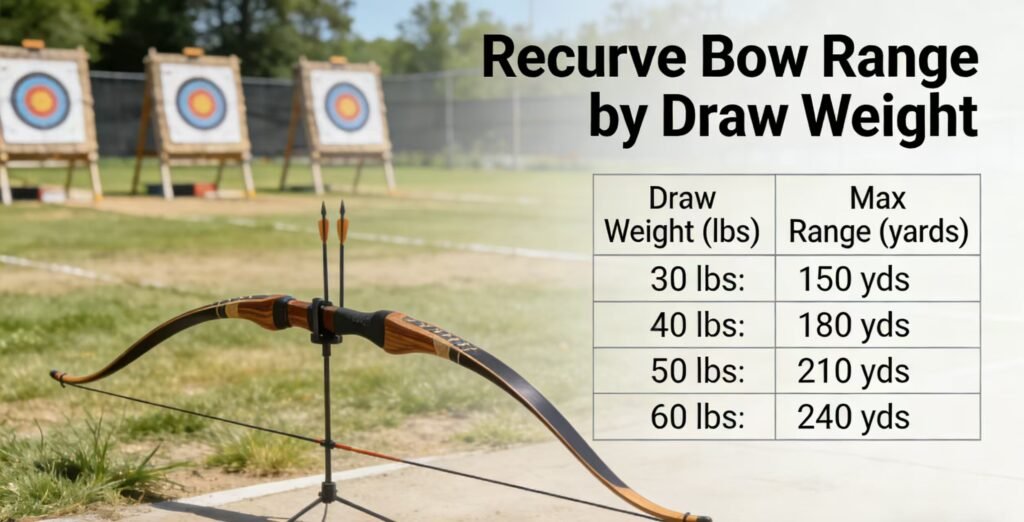
For archers, hunters, and target shooters, one question dominates gear choices: How far can a recurve bow shoot, and how does draw weight change that range? Unlike compound bows with cams and let-off, recurve bows rely on limb design and raw draw weight to deliver speed, energy, and distance. This complete guide breaks down recurve bow range by draw weight, defines effective vs. maximum range, shares real-world yardages for hunting and competition, and helps you pick the right poundage for your goals. Optimized for search engines and actionable for shooters, this article covers everything you need to match recurve draw weight to your shooting range.
What Is Recurve Bow Draw Weight & Why It Drives Range
Draw weight (measured in pounds, lbs) is the peak force required to pull a recurve bow to full draw—typically standardized at a 28-inch draw length. Recurve limbs curve away from the archer at the tips, storing and releasing energy more efficiently than longbows. More draw weight means more stored potential energy, faster arrow speed (feet per second, FPS), flatter trajectory, better wind resistance, and greater downrange kinetic energy (KE).
A reliable rule for recurve bows: every 10 lbs of draw weight adds roughly 15–20 FPS to arrow velocity. Faster arrows fly farther, drop less, and retain lethal or scoring energy longer. While draw weight is the biggest driver of range, draw length, arrow weight, bow tuning, and archer skill also shape your actual usable distance.
Effective Range vs. Maximum Range: Critical Definitions
Before diving into poundage-specific numbers, clarify two non-negotiable terms:
- Effective Range: The distance where you can land consistent, accurate hits with enough energy for hunting penetration or target scoring. This is your real-world working range.
- Maximum Range: The absolute farthest an arrow can travel when shot at a 45° angle, with no regard for accuracy or lethality. This is a theoretical number, not practical for hunting or competition.
For recurves, effective range is far more important than maximum range. Even a high-poundage recurve only delivers reliable accuracy and energy within a narrow window—usually 20–60 yards for most shooters.
Recurve Bow Range by Draw Weight (Real-World Yardages)
Below are tested, real-world ranges for common recurve draw weights, based on 28-inch draw length, 350–450 grain carbon arrows, tuned takedown recurves, and average archer skill. These numbers apply to modern recreational, hunting, and Olympic-style recurves.
10–25 lbs: Youth & Absolute Beginners
- Effective Range: 10–20 yards
- Maximum Range: 80–150 yards
- Arrow Speed: 120–170 FPS
Light poundage recurves are built for kids, new archers, and backyard plinking. They prioritize control and safety over distance. Accuracy and energy drop off sharply past 15 yards, making these bows ideal for short-range target practice and introducing archery fundamentals.
25–35 lbs: Casual Target & Small Game
- Effective Range: 20–30 yards
- Maximum Range: 150–220 yards
- Arrow Speed: 170–200 FPS
This is the sweet spot for recreational shooters and small-game hunters (rabbits, squirrels, turkeys). Arrows fly fast enough for consistent groups at 25 yards, with enough KE for clean small-game harvest. Many female archers and older youth choose this range for all-day comfort without fatigue.
35–45 lbs: Competitive Target & Medium Game
- Effective Range: 30–45 yards
- Maximum Range: 220–280 yards
- Arrow Speed: 200–225 FPS
The most versatile poundage for target archers and deer hunters. Olympic recurve shooters often use 35–40 lbs for 70-meter (76-yard) competition, relying on precision over raw power. For hunting, 40–45 lbs meets most state minimums and delivers enough penetration for ethical medium-game kills at 20–35 yards.
45–60 lbs: Traditional Hunting & Long-Range Target
- Effective Range: 40–60 yards
- Maximum Range: 280–350+ yards
- Arrow Speed: 225–250+ FPS
The top choice for experienced recurve hunters pursuing deer, elk, and wild boar. 50–55 lbs provides excellent KE and penetration, with effective range extending to 60 yards for skilled shooters. Traditional archers and long-range target enthusiasts favor this poundage for balance of power and shootability.
60+ lbs: Heavy Hunting & Traditional War Bows
- Effective Range: 50–70 yards
- Maximum Range: 350–450+ yards
- Arrow Speed: 250+ FPS
Reserved for expert archers and large-game hunting (bear, moose). 60+ lbs recurves deliver extreme power but require significant strength and technique to control accurately. Most hunters avoid this range due to fatigue and reduced accuracy, but it excels for long-distance traditional shooting.
Draw Weight Effective Range Maximum Range Arrow Speed Best Use
10–25 lbs 10–20 yds 80–150 yds 120–170 FPS Youth, beginners
25–35 lbs 20–30 yds 150–220 yds 170–200 FPS Casual target, small game
35–45 lbs 30–45 yds 220–280 yds 200–225 FPS Competition, medium game
45–60 lbs 40–60 yds 280–350 yds 225–250 FPS Hunting, long-range target
60+ lbs 50–70 yds 350–450+ yds 250+ FPS Large game, expert traditional
Key Factors That Alter Recurve Bow Range
Draw weight is king, but these variables directly shift your recurve’s effective and maximum range:
1. Arrow Weight: Heavier arrows (400–500 grains) boost KE and penetration but reduce maximum range; lighter arrows (300–350 grains) fly faster and farther but sacrifice downrange energy.
2. Draw Length: Every 1 inch of draw length adds ~10 FPS, extending effective range by 5–10 yards.
3. Limb & Bow Design: High-performance takedown recurves and Olympic limbs transfer energy more efficiently than basic wooden models.
4. Archer Skill: Proper form, release, and consistency add 10–20 yards to your personal effective range.
5. Environment: Wind, altitude, and temperature change arrow flight and effective range.
Recurve Bow Range for Hunting vs. Target Shooting
Hunting Recurve Range
Ethical recurve hunting relies on shot placement over distance. Most experienced recurve hunters limit shots to 20–35 yards, even with 50+ lbs bows. State regulations often require a 40–45 lb minimum for big game, and effective hunting range tops out at 40 yards for clean, humane kills.
Target Recurve Range
Olympic recurve competitions shoot at 70 meters (76 yards) with 35–40 lb bows, prioritizing accuracy over power. Recreational target archers typically shoot 30–50 yards with 30–40 lb recurves, balancing ease of use and precision.
How to Choose the Right Recurve Draw Weight for Range
- Beginners/Youth: Start at 10–30 lbs. Master form before chasing distance.
- Casual/Target: 30–40 lbs for accurate 30–50 yard shooting.
- Medium Game Hunting: 40–50 lbs for ethical 20–35 yard kills.
- Large Game/Expert: 50–60 lbs for maximum penetration and extended effective range.
Golden Rule: A bow you can shoot accurately all day is better than a heavy bow that causes fatigue and missed shots.
Recurve vs. Compound Bow Range: Key Difference
Recurves have shorter effective ranges than compounds due to no let-off and lower mechanical efficiency. A 60 lb compound may reach 80+ effective yards, while a 60 lb recurve tops out at 60–70 accurate yards. Recurves offer a more traditional, skill-focused shooting experience, while compounds deliver longer usable range with less effort.
Final Thoughts
Recurve bow range is directly tied to draw weight, but effective range beats maximum range for every real-world shooter. Higher draw weight delivers more speed, energy, and potential distance, but your skill, equipment, and goals define your actual usable range. Use the poundage-range chart above as a benchmark, then tune your bow and practice to maximize your accurate, consistent distance.