The Dual Nature of the Curve: Recurve Bows in Sport and Life
The image of an archer drawing a bow is one of the most enduring symbols in human history, representing focus, power, and precision. In the modern era, this ancient tool has evolved into a highly specialized instrument. While the fundamental physics remains unchanged, the application of the bow has diverged into two distinct worlds: the highly regulated, sterile environment of competitive sports, and the rugged, varied landscape of daily recreational use. At the center of both worlds stands the recurve bow, a design that has stood the test of time. While the recurve bows used by Olympic hopefuls and those used by weekend hobbyists share the same DNA, they differ significantly in their configuration, purpose, and the experience they offer to the archer.
To understand the relationship between these two categories, one must first look at the defining characteristic that unites them. A recurve bow is distinct from a traditional longbow in that its limbs curve away from the archer at the tips. This seemingly simple geometric difference is a feat of engineering efficiency. When the string is drawn, these curved tips straighten out, effectively increasing the length of the draw and storing more potential energy than a straight-limbed bow of the same length. This design allows recurve bows to be shorter and more manageable—making them ideal for use on horseback or in dense forests historically—while still delivering high arrow speeds and kinetic energy. Whether the bow is resting on the rack of an Olympic stadium or being carried through the woods by a hunter, this fundamental mechanism of “stored energy through curvature” remains the heartbeat of the design.
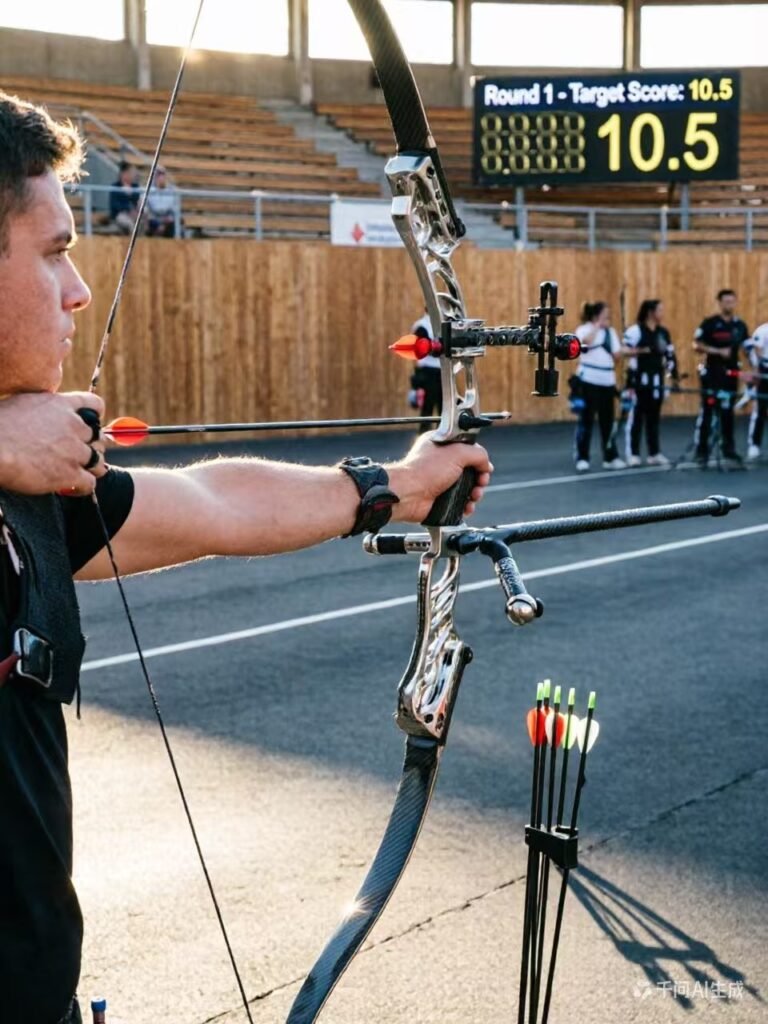
In the realm of competitive sports, specifically the Olympic Games, the recurve bow is a marvel of modern materials science and precision engineering. The recurve bows seen in these arenas are rarely simple wooden staves; they are complex assemblies of aluminum, carbon fiber, and advanced polymers. The “riser”—the central handle part of the bow—is typically machined from a single block of aluminum or magnesium alloy to provide extreme rigidity and lightness. This rigidity is crucial because any flex in the handle translates to lost energy and inconsistent arrow flight.
Furthermore, the sports recurve is a “naked” bow in terms of mechanics but “clothed” in accessories. It is equipped with long, heavy stabilizer rods that protrude from the front and sides of the riser. These are not decorative; they act as counterweights to balance the bow and dampen the violent vibration that occurs upon release. The archer also employs a sight—a pin that can be adjusted with microscopic precision—and a clicker, a small metal blade that makes an audible “click” when the archer reaches their exact draw length, ensuring consistent power for every shot. In this context, the recurve bow is a tool of exactitude, designed to eliminate variables and allow the athlete to perform at the peak of human capability under immense pressure.
Contrast this with the recurve bows found in daily life, used for recreational shooting, traditional archery, or hunting. Here, the philosophy shifts from “maximum precision through technology” to “simplicity and connection.” While modern materials are still used, there is a significant market for wooden risers and limbs that evoke the craftsmanship of the past. These bows are often “takedown” recurves, meaning the limbs can be detached from the riser. This modularity is a key feature for the daily user, allowing for easy transport in a backpack and the ability to swap limbs of different weights (poundage) as the archer’s strength improves.
The “daily use” recurve is often stripped of the heavy stabilization and complex sighting systems found in the Olympics. Many recreational archers prefer “instinctive” shooting, where they look at the target and release without a sight pin, relying on muscle memory and hand-eye coordination similar to throwing a ball. This style of archery is less about hitting the same hole in a paper target fifty times in a row, and more about the rhythm, the form, and the joy of the shot. For hunters, the recurve offers a challenge that modern compound bows (with their let-off and mechanical releases) cannot match; it requires the hunter to get closer to the game and rely on skill rather than mechanical advantage.
Despite these differences in configuration, the training and physical demands of shooting recurve bows remain remarkably consistent across both domains. Unlike the compound bow, which utilizes a system of cams and pulleys to reduce the holding weight at full draw (a feature known as “let-off”), the recurve bow is unforgiving. The draw weight increases linearly; the further you pull, the heavier it gets. At full draw, the archer must hold the entire weight of the bow—often 40 to 50 pounds for an average adult—using only their back muscles and skeletal alignment.
This physical reality dictates that whether one is training for a gold medal or shooting in a local park, the focus must be on “back tension” and proper form. The “sport” archer and the “recreational” archer both utilize the same biokinetic chain: planting the feet, rotating the hips, engaging the scapula, and drawing the string to a specific anchor point on the face. The sensation of the string biting into the fingers (protected by a tab or glove) and the shock of the release are identical. In this way, the recurve bow serves as a great equalizer; it demands respect for the physics of the draw, regardless of whether the target is an Olympic bullseye or a foam block in a backyard.
The maintenance of recurve bows also highlights the gap between professional and personal use. An Olympic archer treats their equipment with the fastidiousness of a surgeon. They constantly tune the “center shot,” adjust the pressure button (plunger), and ensure the tiller (the distance between the string and limb) is perfectly balanced. The bow is a precision instrument that requires constant calibration. Conversely, the daily user’s recurve is built for durability and ease. While care is still taken to keep the string waxed and the limbs free of cracks, the recreational archer does not need to micro-manage the flight of the arrow. The “daily” recurve is a companion, designed to be robust enough to withstand travel and varying weather conditions without requiring a tuning press or a level to function effectively.
In conclusion, while the recurve bows of the sporting world and the everyday world may look different on the surface—one bristling with wires, weights, and sights, the other sleek, wooden, and minimalist—they are kindred spirits. They share the same elegant geometry that has powered human innovation for millennia. The sports recurve represents the pinnacle of what we can achieve when we apply technology to human potential, pushing for the absolute limit of accuracy. The recreational recurve represents the soul of the sport, preserving the tactile, intuitive connection between the archer and the arrow. Whether used to break a world record or to simply enjoy a quiet afternoon outdoors, the recurve bow remains a testament to the perfect curve, bridging the gap between ancient tradition and modern aspiration.